


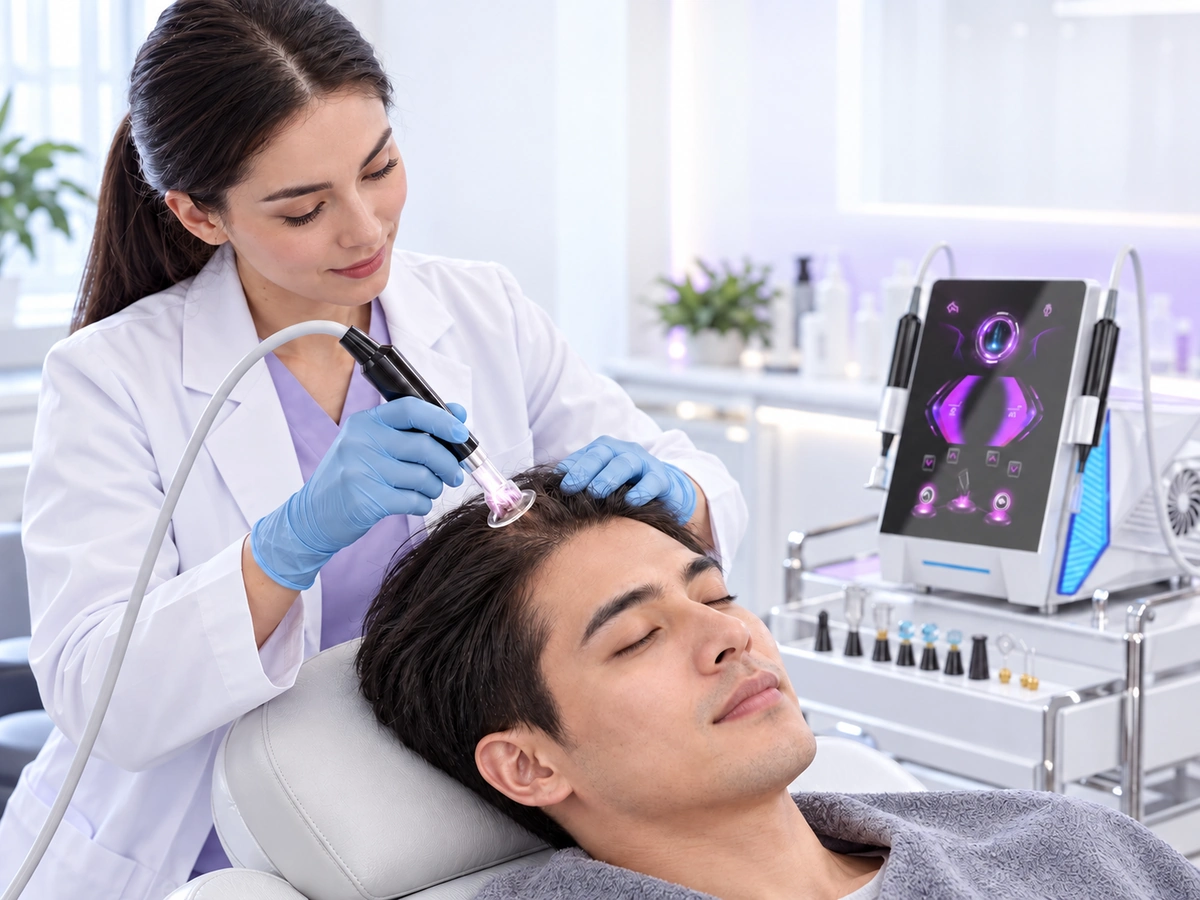
Hair and scalp concerns are multifactorial. A professional consultation should first identify whether the client is presenting with temporary shedding, scalp discomfort, visible flaking, pattern hair loss, irritation, or another condition that requires medical evaluation. Cold plasma can be considered as an adjunctive, non-thermal technology within a broader clinic protocol—not as a substitute for diagnosis.
What is cold plasma?
Cold plasma, also called non-thermal atmospheric plasma, is an ionised gas generated at or near atmospheric pressure while the overall treatment environment is designed to remain substantially cooler than thermal plasma. Depending on the device, the plasma may be produced with a gas-assisted handpiece or through a gas-free configuration.
In professional aesthetics, the relevant point is controllability: the operator selects the handpiece, mode, intensity, distance or contact method, movement pattern, and exposure according to the manufacturer's instructions and the client's skin or scalp response.
Why use cold plasma in a scalp-care protocol?
Scalp quality is an important part of a hair-restoration plan. Excess oil, visible flaking, sensitivity, barrier disruption, and poor treatment adherence can all affect the client experience. A cold plasma protocol may help a clinic create a structured, repeatable scalp-care step before or alongside other professional services.
Use a controlled protocol to support a clean, well-observed treatment environment before topical or device-based services.
Adjust the treatment approach according to sensitivity, client feedback, and the machine's operating instructions.
Position the service as an adjunct to a complete plan, with realistic expectations and appropriate referral when needed.
Combine standardised photographs, consultation notes, and follow-up intervals to assess the overall plan.
Potential benefits for a professional clinic
- Flexible treatment design: interchangeable consumables can help the operator select a suitable contact style for the scalp area and protocol objective.
- Adjustable operation: intensity, mode, and handpiece selection can be adapted to the treatment plan rather than applying one fixed approach to every client.
- Gas-assisted or gas-free options: the latest system can be used according to the selected configuration and the clinic's workflow.
- Documentation-friendly workflow: a clinic can record the selected handpiece, mode, intensity, exposure, client sensation, and aftercare advice for more consistent follow-up.
- Service differentiation: scalp-care protocols can complement existing facial, skin-rejuvenation, or hair-restoration services when appropriately positioned.
These are operational and protocol benefits. They should not be presented as guaranteed hair growth, a cure for alopecia, or a replacement for a medical hair-loss treatment plan.
Scalp-care and hair-restoration applications
1. Scalp-care consultation and preparation
Begin with a consultation, scalp observation, client history, and photographs taken under consistent conditions. Where the scalp shows persistent inflammation, unexplained lesions, infection-like symptoms, sudden shedding, or significant pain, pause the cosmetic protocol and refer the client to a qualified healthcare professional.
2. Supportive hair-restoration sessions
For clients already following a medically supervised or clinic-approved hair-restoration plan, cold plasma may be positioned as a supportive session. The operator should clearly explain what the device is intended to do, what it cannot establish, and when progress will be reviewed.
3. Scalp and hairline maintenance
Maintenance sessions should be based on the client's condition, response, and the clinic's written protocol. Avoid promising a universal schedule. Document the interval, selected consumable, operating mode, and any observed response.
4. Combined aesthetic-clinic workflows
A clinic may use the platform within a wider menu of services, but combination protocols should be validated by a trained professional. Do not combine treatments simply because they are available on the same day; consider skin integrity, client sensitivity, contraindications, and recovery requirements.
Treatment guide: a responsible clinic workflow
Consult and assess
Record the client's objective, relevant history, scalp condition, current products, medications if disclosed, and any reason for referral.
Select the protocol
Choose gas-assisted or gas-free operation, the appropriate consumable, intensity, and mode according to the instructions and training.
Prepare the area
Follow the clinic's hygiene procedure, prepare the scalp as instructed, and protect the client's eyes and surrounding areas when required.
Perform controlled passes
Use the specified movement, contact or distance, exposure, and treatment pattern. Monitor comfort and stop if an unexpected reaction occurs.
Document and advise
Record the settings and client response. Provide aftercare instructions and explain when the client should contact the clinic or seek medical advice.
Review progress
Use consistent photographs and consultation notes. Evaluate the whole care plan rather than attributing every change to one device.
What should clinics look for when selecting a machine?
Equipment selection should focus on repeatability, operator control, support, and the fit with the clinic's existing workflow. Before purchase, ask the supplier for the exact configuration, compatible consumables, operating instructions, training scope, warranty terms, and electrical requirements.
| Operating concept | Non-thermal atmospheric plasma platform for professional aesthetic protocols |
|---|---|
| Applications | Scalp care, hair-restoration support, and selected skin-care protocols according to the configuration |
| Consumables | Consumable numbers 1, 2, 3, 4, 5, and 6 can be used for scalp care and hair-restoration applications |
| System selection | Two operating systems; the operator can select the corresponding cold system when required |
| Gas options | Gas-assisted or gas-free use, depending on the selected system and treatment requirement |
| Training | Operation manual, training videos, and WhatsApp online training support |
| Warranty | Two-year free warranty with free replacement of parts during the warranty period, subject to the warranty terms |
| US configuration | 110 V configuration and US power plug available on request |
Safety, training, and communication
A professional device should be operated only by appropriately trained personnel and within the scope allowed by local rules. The term “cold” does not mean that every setting is risk-free. Sensation and skin response can vary according to the mode, intensity, handpiece, exposure, scalp condition, and client sensitivity.
Use the manufacturer's manual as the primary operating reference. Staff should know how to identify the machine's error codes, stop the session, document an unexpected response, and escalate a concern. Emmalaser provides an operation manual, videos, and WhatsApp training support; the clinic remains responsible for local clinical governance and staff competency.
Why this technology may fit a hair clinic
For a clinic, the value of a cold plasma machine is not only the device itself. The strongest business case comes from a clear protocol, consistent documentation, trained staff, transparent client communication, and a service pathway that complements—not replaces—medical evaluation.
Review the available configuration, handpieces, consumables, operating options, and support information on the product page.
https://emmalaser.com/products/cold-plasma-machineFrequently asked questions
What is a cold plasma machine used for in scalp care?
A professional cold plasma machine can be incorporated into non-thermal scalp-care protocols designed to support the treatment environment and the appearance of the scalp. It should be used according to the manufacturer's instructions and local professional requirements.
Can cold plasma replace medical hair-loss treatment?
No. Cold plasma should not be presented as a replacement for medical diagnosis or evidence-based treatment of alopecia. Clients with persistent or progressive hair loss should be referred to a qualified healthcare professional.
Can the machine be used with or without gas?
Depending on the configuration, the latest system can support gas-assisted or gas-free operation. The operator should select the appropriate mode and follow the supplied instructions for the specific handpiece.
What training is provided with the machine?
Emmalaser provides an operation manual and training videos. Online WhatsApp training can also be arranged for equipment operation and protocol familiarisation.
How should a clinic choose a scalp-care handpiece?
Handpiece selection should follow the intended treatment area, contact method, operator training, and the machine's instructions for use. Consumables numbered 1 through 6 can be used for scalp-care and hair-restoration protocols with this system.
Is cold plasma treatment painful?
Client sensation depends on the selected mode, intensity, handpiece, treatment area, and individual sensitivity. A trained professional should begin conservatively and monitor comfort throughout the session.
Selected reading
- Cold atmospheric plasma device induces hair growth: A nonrandomized, controlled study, Journal of the American Academy of Dermatology.
- Non-thermal plasma promotes hair growth by improving the microenvironment of hair follicles.
- Non-thermal atmospheric pressure plasma activates Wnt/β-catenin signaling related to hair growth.
- Cold atmospheric plasma applications in dermatology.

